
Introduction
In the piping industry, there is a common myth: “Seamless is always better.”
While Seamless pipes are stronger by nature, they are also significantly more expensive. For many applications, a high-quality Welded (ERW) pipe is not just “good enough”—it is actually the smarter engineering choice.
At Dhanvika Global, we supply both. Our goal isn’t to sell you the most expensive pipe, but the right pipe for your specific pressure and budget requirements.
What is a Seamless Pipe? (The “High Pressure” King)
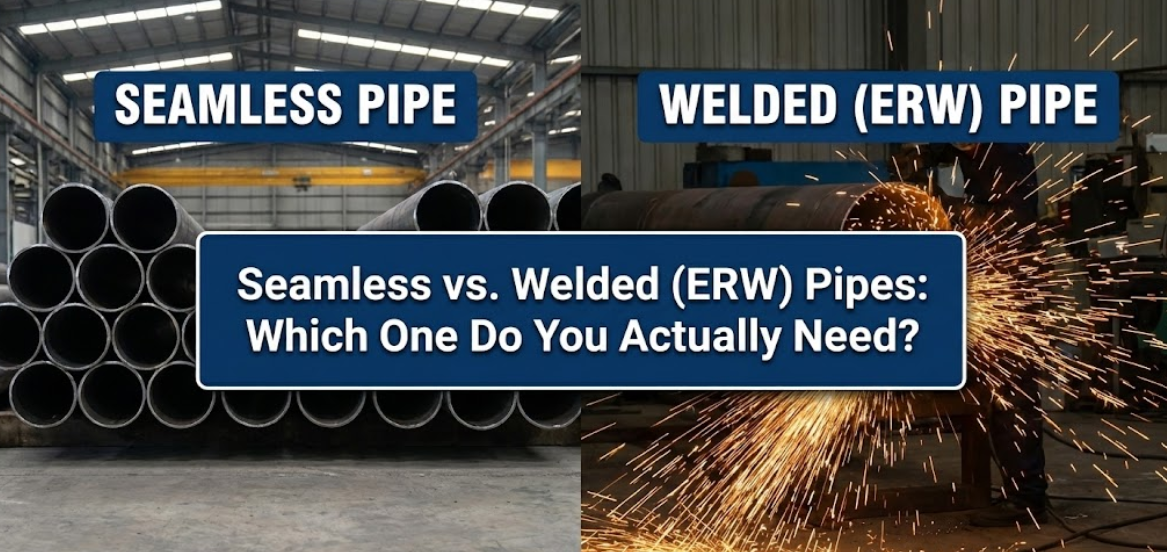
As the name suggests, a Seamless pipe has no weld seam. It is manufactured by extruding a solid steel billet through a piercing rod to create a hollow tube.
Why it wins:
- Uniform Strength: Because there is no weld seam, the strength is equal around the entire circumference.
- High Pressure: It can withstand roughly 20% higher working pressures than a welded pipe of the same size.
- Reliability: No weld means no “weak point” for potential corrosion or leaks in extreme conditions.
Best for: High-pressure oil lines, boiler tubes, and critical hydrocarbon services.
What is a Welded (ERW) Pipe? (The Cost-Effective Choice)
Welded pipes are made by rolling a flat steel plate (coil) into a cylinder and welding the edges together. Modern technology, specifically Electric Resistance Welding (ERW), has made the seam almost invisible and incredibly strong.
Why it wins:
- Precision: Because it starts as a flat sheet, the wall thickness is much more consistent than seamless pipe.
- Availability: Easier to manufacture in large diameters (above 24 inches).
- Surface Finish: typically smoother internally and externally.
Best for: Low/Medium pressure water lines, structural supports, and architectural uses.
⚔️ The Technical Showdown
| Feature | Seamless Pipe | Welded (ERW) Pipe |
| Manufacturing Process | Extrusion (from solid billet) | Rolling & Welding (from strip) |
| Pressure Rating | High (Standard: ASME B31.3) | Moderate (Roughly 80% of Seamless) |
| Wall Thickness | Variable (Slight inconsistencies) | Very Consistent |
| Available Sizes | Typically up to 24 inches | Up to 100+ inches |
| Lead Time | Longer (Harder to make) | Short (Readily available) |
💰 Price Comparison: The “Budget” Factor
This is where the decision usually happens.
Seamless pipes typically cost 25% to 35% more than Welded pipes.
- If you are building a high-pressure boiler: You must pay the premium for Seamless. Safety is the priority.
- If you are building a water transport line: Paying 30% extra for Seamless is a waste of money. ERW pipe will last just as long and handle the pressure easily.
Pro Tip: Modern manufacturing standards (like ASTM A312 for Stainless) require welded pipes to be fully tested (X-Ray or Hydro-test). A tested Welded pipe is often just as reliable as a generic Seamless pipe.
🏭 Dhanvika Case Study: Saving a Client ₹5 Lakhs
We recently worked with a fire-fighting contractor in Pune, Maharashtra. Their initial tender requested “Seamless Schedule 40 Pipes” for the entire fire sprinkler network.
The Problem: The cost of Seamless pipe was pushing the project 15% over budget.
Our Recommendation:
We reviewed the pressure requirements. Fire sprinkler systems typically operate at pressures well within the range of high-quality ERW pipes. We suggested switching to ERW Steel Pipes (Heavy Grade) which met all IS:1239 standards.
The Result:
The client saved approximately ₹5,00,000 on material costs without compromising a single safety standard. The system passed all hydro-tests on the first try.
Conclusion
- Choose Seamless if: You have high pressure, high temperature, or a critical chemical application.
- Choose Welded if: You need consistent dimensions, larger diameters, or a cost-effective solution for low/medium pressure.
Not sure which one your drawing requires? Send us your specification sheet. At Dhanvika Global, we can quote both options so you can compare the price difference instantly.